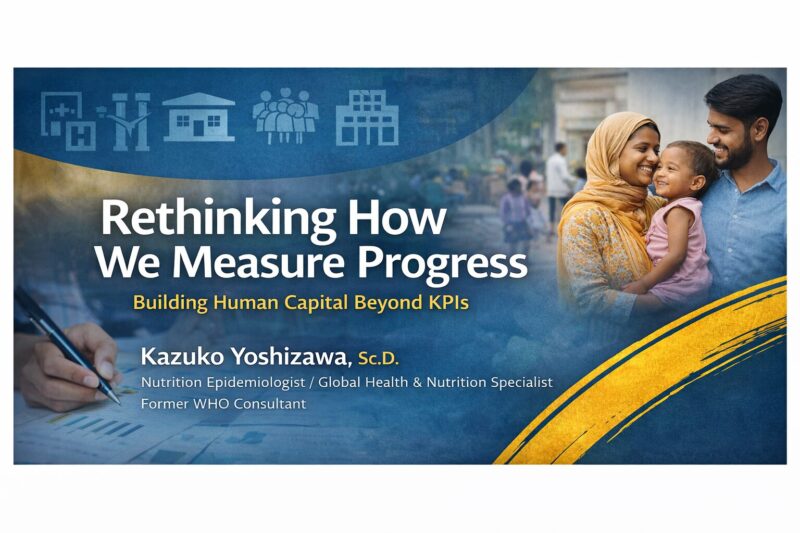
Author: Kazuko Yoshizawa, Sc.D. – Nutrition Epidemiologist; Global Health & Nutrition Specialist; Former Visiting Scientist, Harvard T.H. Chan School of Public Health; Former WHO Consultant (Public Nutrition Policy & Capacity Building)
A Message from the World Bank
Recently, I received an invitation from the World Bank to attend an online livestream titled “Building Human Capital & Measuring Progress.”
At first glance, it appeared to be a standard event announcement. However, the title immediately caught my attention—because it echoed a question I have repeatedly confronted in development practice.
When Measurement Itself Becomes Difficult
Human capital, institutional capacity, and human resource development are widely recognized as essential for sustainable development. Yet these elements are notoriously difficult to capture through short-term indicators.
When an institution like the World Bank explicitly raises the question of how to “measure progress,” it signals that measurement itself is under strain. The challenge is no longer simply technical—it is conceptual.
Lessons from Timor-Leste
As a WHO consultant, I was involved in designing a national nutrition capacity-building plan for the Ministry of Health in Timor-Leste. In that project, final KPIs were clearly defined: wasting and stunting among children under five.
These indicators were selected deliberately. They are internationally comparable, aligned with WHO standards, directly linked to SDG 2.2, and supported by well-established intervention strategies.
At the same time, another factor was equally critical: whether the Ministry itself could collect, interpret, and use data for policy decisions. This institutional capacity was central to the project’s long-term success.
Why Institutional Capacity Was Not a Final KPI
Despite its importance, institutional capacity was intentionally not set as a final KPI. This was not because it mattered less—but because forcing it into short-term evaluation risked distorting its meaning.
Capacity building unfolds over years, not project cycles. It involves learning, judgment, institutional memory, and professional practice—dimensions that resist reduction to numeric targets.
Instead, we treated institutional capacity as a foundational condition: something that enables meaningful measurement, rather than something to be optimized for immediate reporting.
A Shared Turning Point
Seeing the World Bank raise this question suggests that this tension is now widely recognized at the institutional level. The issue is no longer whether to measure—but how to responsibly live with what cannot be fully measured.
I do not oppose KPIs. I believe in measuring what can and should be measured.
However, as Amartya Sen has argued, what we choose to measure reflects what we choose to value. In Timor-Leste, children’s nutritional status was measured. Institutional capability was protected from premature quantification—precisely because it mattered.
The World Bank’s invitation felt like a quiet confirmation that development evaluation is entering a more reflective phase—one that acknowledges evaluative uncertainty as part of responsible design.
▶ 関連記事:
・TORを読み解く技術 ― 国際開発プロジェクトにおける設計判断と評価のあいだ
・SDGsって無理がある? ― その違和感と“本当の意味”を解き明かす
© 2026 Kazuko Yoshizawa. All rights reserved.

コメント